
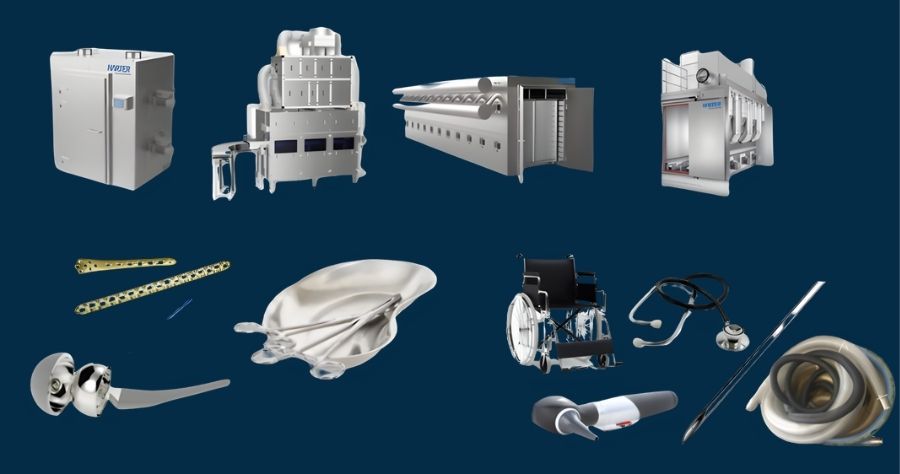
Which design is most suitable depends primarily on the product, throughput, cycle time, degree of automation, and available space. A chamber heat pump dryer is often suitable for flexible batch processes, sensitive parts, and changing products. A tray heat pump dryer is a good fit when many smaller batches need to be dried evenly on inserts, trays, or racks. A continuous heat pump dryer is usually the better choice if the drying process is to be integrated continuously into a production line.
A quick decision logic for companies
For management, production, purchasing, and operations, the design is not just a machine-related question. It determines whether a drying process is stable, economical, and integrable into the existing workflow.
A chamber heat pump dryer operates as a closed drying room for individual batches. It is useful when products are introduced manually, using trolleys, racks, baskets, or individual carriers, and when production involves a high variety of versions.
A tray heat pump dryer is also a batch dryer but usually utilizes multiple inserts or levels. This allows products to be dried in a sorted, flat, and reproducible manner—for example, components, powders, granules, food, pharma-related products, or sensitive components.
A continuous heat pump dryer is designed for continuous processes. Products pass through the dryer on a belt, chain, workpiece carrier, basket, or rack. This design is suitable when cycle time, automation, and line integration are the priorities.
When a chamber heat pump dryer is the better fit
A chamber heat pump dryer is often the right choice if you need to remain flexible. This applies to companies with changing products, different batch sizes, irregular capacity utilization, or sensitive components where drying parameters are adjusted per product.
Typical applications include small parts, precision parts, jigged goods, painted parts, cleaned components, medical devices, or electronics manufacturing parts. This design is particularly helpful when products cannot be easily transported on a belt.
Heat pump drying works with dehumidified process air. At HARTER, the Airgenex® system is used for this purpose, where air dehumidification and air guidance are tailored to the product and process. For an overview of suitable systems, it is worth taking a look at the drying solutions from HARTER.
The chamber approach is particularly strong if you want to store various recipes. A recipe describes typical parameters such as temperature, drying time, air volume, air speed, and, if necessary, intermediate movements or blow-off stages.
A potential disadvantage lies in handling. If batches are moved in and out manually, this creates personnel requirements, waiting times, and coordination efforts in shift operations. In German companies, occupational safety, ergonomics, works councils, and documentation requirements should be considered early on.
When a tray heat pump dryer is the better fit
A tray heat pump dryer is suitable when products are to be dried in an orderly fashion on several levels. Trays are inserts, sheets, sieves, or carriers on which products are placed flat or in defined layers.
This design is particularly interesting when many small parts, sensitive surfaces, food, pharma-related products, or laboratory and production batches must be dried reproducibly. The level structure facilitates the separation of batches, variants, or article groups.
The most important technical point is the air guidance. Dry air must reach every level evenly; otherwise, upper, lower, or edge areas will dry differently. Therefore, air volume flow, flow direction, loading density, and the distance between the trays should be tested.
For companies in sensitive industries, documentation and reproducibility are central. This concerns batch records, cleaning processes, release protocols, and, if applicable, requirements from quality assurance or auditing. For applications with increased hygiene or quality requirements, the Pharma and Medical Technology page provides a suitable classification.
A tray dryer is less suitable if very high quantities are to be processed without manual intermediate handling. In such cases, a continuous system may be more economical because it reduces handling and fits better into automated processes.
When a continuous heat pump dryer is the better fit
A continuous heat pump dryer is usually the best choice if your process runs continuously. This applies, for example, after washing systems, rinsing processes, electroplating lines, coating systems, food processes, or automated parts production.
The advantage lies in integration. Products are not collected, temporarily stored, and dried in batches, but instead run directly through the dryer. This can reduce waiting times, make material flows clearer, and allow for better planning of cycle times.
In continuous dryers, the inlet and outlet openings are technically decisive. The larger the openings, the more difficult it becomes to keep energy in the system and ensure constant conditions. Therefore, opening cross-sections, sealing, air curtains, belt speed, and product geometry must be considered together.
A continuous heat pump dryer is particularly worthwhile for stable product families and predictable volumes. In industrial drying, this design is often useful where quality, cycle time, and energy use are to be improved simultaneously.
The investment is often higher than for simple batch systems. However, fewer manual work steps, lower work-in-progress, better line availability, and more stable process data can justify the expense. A thorough economic efficiency calculation covering energy, personnel, scrap, rework, space, and downtime risks is crucial.
Key terms briefly explained
A heat pump dryer extracts moisture from the process air and returns the dried air to the drying chamber. This creates a closed or largely closed air circuit that operates more independently of the ambient climate and season than simple exhaust air systems.
At HARTER, Airgenex® refers to the heat pump module for industrial condensation drying. The air is dehumidified, reheated, and guided specifically to the product.
A technical center is a testing area where real products are tested under practical conditions. Parameters such as temperature, time, humidity, air speed, air volume flow, and air guidance are determined there.
A precooler precools moist process air before the moisture condenses at the air cooler. The air cooler extracts moisture from the air, and the air heater then brings it back up to process temperature.
The process air fan ensures air exchange between the heat pump module and the drying chamber. The dryer interface describes the transition where moist air is removed from the drying area and dry air is reintroduced.
Electroplating is a surface process in which components are electrochemically coated. After rinsing and cleaning processes, drying is often quality-critical because water residues, spots, or deposits can impair the surface.
Comparison by decision criteria
For the design decision, you should not only look at the machine but at the overall process. This includes input moisture, water load, product geometry, loading, cycle time, temperature limit, quality goal, and automation.
Industry requirements also play a role. Hygiene concepts in food production differ from those in surface treatment or sewage sludge drying. The Industry Solutions from HARTER page provides an overview of application areas.
Checklist for selecting the appropriate design
Realistic Example from a Medium-Sized Company
A medium-sized supplier with 420 employees cleans precision parts after machining. The parts then go to assembly and final inspection. Involved are management, production management, quality assurance, purchasing, maintenance, HR for shift planning, and the works council due to new operating procedures.
Initially, a chamber heat pump dryer is discussed because many different components are processed. However, production reports that about 70 percent of the volume consists of three fixed product families. At the same time, waiting times occur because cleaned parts are collected before drying.
The critical components are tested in the technical center. It turns out that a continuous heat pump dryer with a defined belt speed is suitable for the standard products. For special parts with complex geometry, a small chamber dryer remains sensible because longer programs and special loadings are possible there.
The typical stumbling block lies in the interface between cleaning and drying. If parts are loaded too densely or handed over dripping wet, the water load increases significantly. Compressed air-free blow-off before drying can stabilize the process if blind holes, undercuts, or scooping geometries are present.
The result is a combined decision: continuous for the main volume, chamber for special parts. For companies with a similar starting point, it is not the individual design that is decisive, but the separation between standard and exceptional processes. Information on the technological approach can be found under Why HARTER.
Costs, implementation, and typical influencing factors
The costs of a heat pump dryer depend heavily on the design, size, water extraction capacity, automation, material version, control system, interfaces, and documentation requirements. A manually operated chamber dryer is often easier to integrate than a fully automatic continuous dryer with a line, sensors, and data connection.
Implementation projects often take several months depending on complexity. Influencing factors include drying tests, internal approvals, layout planning, budget processes, delivery times, utility connections, installation windows, and validation during operation.
For German companies, GDPR, works councils, and role rights are also relevant as soon as personal operator data, shift evaluations, or digital process protocols are processed. With pure machine data acquisition, the effort is lower, but access rights and storage periods should still be clearly defined.
In regulated or quality-critical areas, a connection to operational data acquisition can be useful. Batch status, runtime, temperature, faults, approvals, and maintenance information can then be documented traceably. This helps purchasing and management with operating cost analyses and supports production and quality assurance during audits.
Typical Follow-Up Questions
Recommendation for practice
Choose a chamber heat pump dryer if flexibility, product changes, and special parts are the priority. Choose a tray heat pump dryer if batches are dried in an orderly fashion on several levels and reproducible air guidance across all inserts is possible.
Choose a continuous heat pump dryer if high volumes, fixed cycles, and an automatic line are decisive. This design can greatly simplify material flow but requires more precise planning of the interfaces.
The safest decision is made through drying tests with original parts. Not only optimal conditions should be tested, but also borderline cases: maximum loading, most complex geometry, highest water load, most sensitive material, and shortest permissible cycle time.
For applications in the food industry, hygiene, cleanability, and gentle temperatures can be particularly important. Suitable insights are provided on the Food Drying page.
FAQ
Is a chamber dryer always the most flexible solution?
A chamber dryer is often very flexible, but not automatically the best solution. If your production processes high volumes with fixed cycles, a continuous dryer can be more economical despite higher planning complexity. The product mix, handling, cycle time, and quality goal are decisive.
When is a tray dryer worthwhile?
A tray dryer is worthwhile if products are to be dried cleanly separated, flat, or on several levels. It is particularly suitable for smaller batches, sensitive parts, and applications where uniform air distribution across all inserts can be ensured.
What is the most important advantage of a continuous heat pump dryer?
The most important advantage is the continuous integration into the production process. Products can pass directly from the upstream process into drying. This reduces intermediate storage, manual handling, and coordination effort between work steps.
Which design is sensible for frequently changing products?
For frequently changing products, chamber or tray dryers are often more sensible than a pure continuous system. They allow for recipe changes, flexible loading, and better adaptation to special parts. For larger standard volumes, a combination of continuous and batch solutions can also be sensible.
Why are drying tests so important?
Drying tests show which temperature, time, air speed, air volume, and air guidance work for your product. They reduce the risk of a wrong decision and help to design the construction type, size, and process parameters reliably.
Can a heat pump dryer be connected to operational data acquisition?
Yes, a connection can be useful if process data, faults, runtimes, batch information, or energy metrics are to be documented. IT, production, quality assurance, and, if applicable, the works council should be involved early on.
Which design fits when space is limited?
When space is limited, the solution depends on the material flow. A chamber dryer can be compact but requires space for loading and trolley handling. A continuous dryer requires length and interface area but can reduce intermediate buffers in return.
What role does HARTER play in the selection?
HARTER supports the selection through consulting, drying tests, design, and integration into the existing process. The goal is a design that brings together product quality, energy use, cycle time, and usability in a practical way.


