
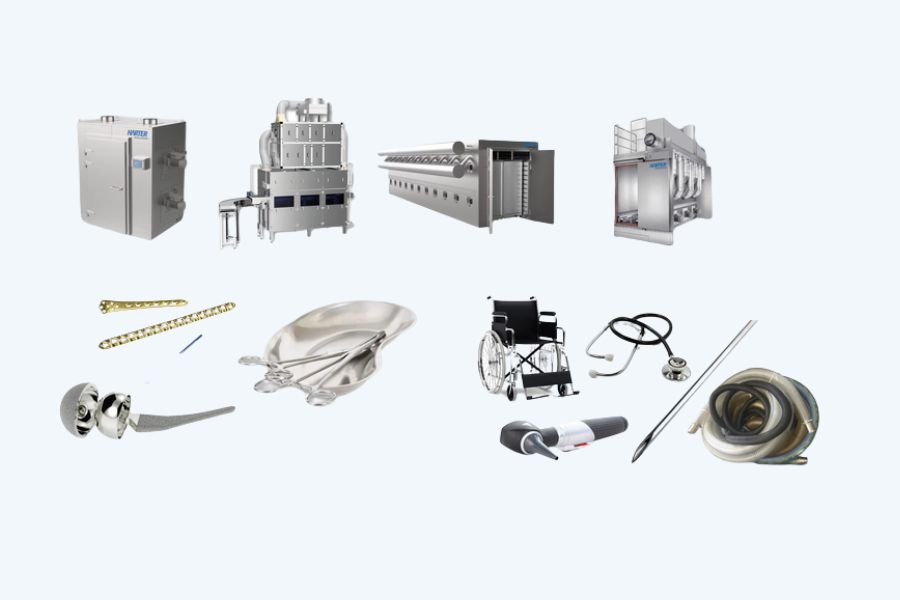
Heat pump condensation drying is particularly suitable for products that require gentle, spot-free, energy-efficient, and reproducible drying. Typical examples include metal and plastic parts after aqueous cleaning, electroplated components, bulk materials, rack goods, painted surfaces, precision parts, medical technology components, food, and certain sludges. The process is especially interesting when low temperatures, constant process conditions, and controlled air routing are important. However, whether a product is suitable should always be checked based on water load, geometry, target residual moisture, cycle time, and quality requirements.
What makes heat pump condensation drying attractive for products
Heat pump condensation drying works with dehumidified process air in a controlled circuit. The air absorbs moisture from the product, is then dehumidified, and returned to the drying chamber. This creates a stable process that is largely independent of the ambient climate, season, and hall air.
This is particularly interesting for companies when quality, energy consumption, and process reliability must be considered simultaneously. Drying typically takes place at comparatively low temperatures. This protects temperature-sensitive products, surfaces, plastics, coatings, and delicate geometries.
The decisive factor is not just the dry air, but how it is guided to the product. Air routing means that the process air is directed through the dryer in such a way that it also reaches critical areas. These include boreholes, undercuts, blind holes, gaps, bulk materials, and densely loaded racks.
An overview of typical applications can be found under Drying solutions by industry.
Products after aqueous cleaning
Components that must be completely dry after aqueous cleaning are very well suited. These include metal parts, plastic parts, hybrid components, assemblies, precision components, and parts with tight tolerances. Especially when classic hot air, compressed air, or centrifuging are not reliably sufficient, heat pump condensation drying can offer advantages.
Typical requirements are spot-free surfaces, short cycle times, low residual moisture, and a reproducible result. When switching from alcoholic to aqueous cleaning, drying often becomes a critical process step because water evaporates differently and complex geometries can remain moist for longer.
In this context, a dryer is the process chamber in which products are dried in a controlled manner. In industrial systems, temperature, air volume flow, air speed, dehumidification, and air routing are tailored to the product. For decision-makers in production and purchasing, it is important that these parameters are clearly described in the proposal.
Further information on industrial fields of application is provided by industrial drying.
Electroplated components and surfaces from electroplating
Electroplating refers to an electrochemical process in which surfaces are provided with metallic layers. After rinsing, coating, or finishing processes, components often need to be spot-free and completely dry. This is exactly where heat pump condensation drying can be particularly suitable.
Typical products include rack goods, barrel goods, bulk materials, stamped parts, fasteners, decorative surfaces, technical coatings, and components with blind holes or undercuts. Scooping geometries, i.e., areas where water remains trapped, are critical. Here, adapted air routing or compressed-air-free blowing-off as a preliminary stage can be useful.
For electroplating shops, it is also relevant that different products can run through the same dryer. Job platers often have a wide range of parts with changing requirements. In such cases, the design should be oriented not just toward the simplest component, but toward the most difficult geometries.
If sludges are also produced during electroplating, the drying of residual materials can also become economically relevant. Information on this can be found under Drying of sewage sludge and sludges.
Bulk materials, barrel goods, baskets, and tubs
Bulk materials are particularly suitable if they are to be dried directly in the container, in barrels, baskets, tubs, or mesh baskets. Examples include small parts, screws, nuts, springs, stamped parts, plastic parts, electronic components, or small precision parts. The challenge lies in the fact that air must be guided not just over the surface, but as homogeneously as possible through the bulk material.
For bulk materials, the combination of container, fill height, movement, air routing, and water load determines the result. Some products can be dried statically. Others benefit from intermittent movement, vibration, or targeted flow-through. A general statement such as “suitable for bulk material” is therefore not sufficient in a proposal.
A process air fan ensures the necessary air exchange between the dehumidification unit and the drying chamber. The pre-cooler pre-cools moist air, the air cooler removes moisture through condensation, and the air heater brings the dehumidified air back up to process temperature. The dryer interface describes the technical transition between air treatment and the drying chamber.
Rack goods, complex components, and large product windows
Rack goods are often well-suited for heat pump condensation drying when components are dried on product carriers after cleaning, rinsing, electroplating, or coating. Typical products include metal profiles, housings, brackets, fittings, technical components, automotive supplier parts, and larger components with demanding surfaces.
Product windows, rack dimensions, loading density, distance between parts, and dripping behavior are important. If products hang too closely together, air cannot reliably reach certain areas. If components scoop water, standing water must either be reduced beforehand or specifically removed from critical areas.
For shift operations, it is also crucial that the dryer maintains the cycle time of the line. It is not enough for a single product to become dry in a laboratory test. The process must also run stably in real three-shift operation, including loading, unloading, malfunctions, breaks, maintenance windows, and product changes.
Suitable dryer types and designs can be found under Dryers for industrial applications.
Painted, coated, and temperature-sensitive products
Painted and coated products are particularly suitable when the surface needs to dry gently and evenly. High temperatures can stress paints, adhesives, plastics, or coatings. In contrast, heat pump condensation drying often works with lower process temperatures and very dry air.
Suitable examples include painted metal parts, plastic parts, components with water-soluble paints, coated surfaces, adhesive applications, or products after surface treatment. It is important that drying occurs not only quickly but also homogeneously. With paints, drying that is too aggressive can lead to tension, surface defects, or an uneven result.
The air must be guided so that all relevant surfaces are reached evenly. An optional cooling step can also be useful if products require a defined further processing temperature after drying.
Precision parts, medical technology, and sensitive components
Precision parts often place high demands on residual moisture, low particle count, spot-free results, and documentation. Examples include miniature parts, sensor components, electronic components, medical technology parts, watch and jewelry components, or high-precision metal and plastic parts. Here, it is not just the drying time that is decisive, but the reproducible quality result.
In medical technology and regulated production environments, documentation, operator rights, process data, and approval processes also count. When user accounts, recipe changes, or batch protocols are processed, GDPR, IT security, and internal role rights should be considered. The works council may need to be involved if personal performance or operator data could be evaluated.
A technical center is particularly valuable here. There, products can be tested under realistic conditions, such as regarding temperature, time, humidity, air speed, air volume flow, and air routing. Further information on sensitive industries can be found under Drying for pharma and medical technology.
Food and hygienically sensitive products
Certain foods can also be suitable for heat pump condensation drying if low temperatures, defined residual moisture, and product-gentle conditions are important. Examples can be ingredients, sensitive raw materials, granules, piece goods, or processed products, provided the material, hygiene requirements, and process management are appropriate.
For food, in addition to drying performance, cleanability, material selection, hygiene zones, documentation, and traceability also count. Stainless steel, good accessibility, defined cleaning processes, and clear responsibilities are often important criteria. Drying must not change the product in an undesirable way, for example, through excessively high temperatures, excessive air movement, or uneven moisture distribution.
For companies with quality management, shift operations, and approval processes, the proposal should therefore not only state technical performance. It should also describe how cleaning, operation, maintenance, documentation, and process monitoring are implemented. Further information can be found under Drying in the food industry.
Checklist: Which products are particularly suitable?
Realistic Example from a Medium-Sized Company
A medium-sized manufacturer with 650 employees produces metal and plastic components for mechanical and electrical engineering. After aqueous cleaning, water residues remain in blind holes and undercuts on some components. Production reports rework, quality assurance documents spots, and purchasing is tasked with comparing proposals for a new dryer.
The project involves management, production management, purchasing, quality assurance, maintenance, IT, and the works council. Management wants to reduce energy and scrap costs. Production demands a stable cycle time in two-shift operation. Quality assurance requires defined residual moisture and traceable acceptance criteria. IT checks whether recipe data and operator rights can be connected to existing systems.
In the technical center, the most critical components are tested, not just the simplest ones. This shows that a mere increase in temperature is not enough. Decisive factors are targeted air routing, a suitable loading concept, and pre-removal of standing water residues. A typical stumbling block is that the product baskets are initially loaded too densely. Only after adjusting the loading and air routing does the result become stable.
For the company, the result is particularly relevant because it is not just a single product that needs to be dried. The dryer is intended to serve several product families. Therefore, recipes, operating rights, maintenance windows, acceptance protocols, and interfaces for production data acquisition are already defined in the proposal phase.
When products are less suitable
Not every product is automatically ideal for heat pump condensation drying. Products that require extremely high temperatures, where chemical reactions are only triggered by high heat, or where solvents, explosion protection requirements, or special exhaust air treatment are the focus, may be less suitable. In such cases, a precise technical examination is necessary.
Very dense bulk materials, strongly scooping geometries, or products with hidden liquid pockets can also be challenging. This does not mean they are unsuitable. It means that air routing, pretreatment, movement, blowing-off, or the loading concept must be designed with particular care.
For purchasing, it is important to note: Statements like “suitable for all products” are too general. A decision only becomes reliable when sample parts, water load, target residual moisture, temperature limits, and cycle time are considered together.
Costs, implementation, and decision factors
The investment depends heavily on the product, size, automation, material design, drying performance, interfaces, and documentation requirements. Compact manual systems can start in the lower five-figure range. Fully automated custom systems with conveyor technology, process integration, and extensive documentation can be significantly higher.
Depending on complexity, implementation often takes several months. Influencing factors include the availability of sample parts, scope of testing, layout approval, design, manufacturing, assembly, commissioning, and internal approvals. In larger companies, additional coordination with occupational safety, data protection, IT, the works council, and quality assurance often extends the project schedule.
A clear requirement specification is therefore crucial. It should contain product data, process data, quality goals, cycle times, documentation requirements, operating concept, and interfaces. This allows for checking whether a solution from HARTER or another provider is technically and economically suitable for the application.
Typical Follow-Up Questions
FAQ
Which product groups are best suited for heat pump condensation drying?
Products after aqueous cleaning, electroplated components, rack goods, bulk materials, precision parts, painted surfaces, medical technology components, certain foods, and sludges are particularly suitable. Water load, geometry, material, target residual moisture, and cycle time are always decisive.
Why is the process interesting for sensitive products?
The process works with dehumidified air and often comparatively low temperatures. This allows temperature-sensitive materials, coatings, plastics, and surfaces to be dried more gently than with many high-temperature processes. Concrete suitability should be verified through tests.
Is heat pump condensation drying suitable for bulk material?
Yes, many bulk materials can be suitable if the air routing, fill height, container, and movement are designed appropriately. It is critical that the dry air reaches the moisture even within the bulk material. Therefore, tests with real products are particularly important.
What role does product geometry play?
Geometry is a central factor. Blind holes, undercuts, narrow gaps, and scooping areas retain water longer. Such products can be suitable but often require targeted air routing, adapted loading, or blowing-off as a preliminary stage.
Can the process be integrated into existing production lines?
Yes, integration is often possible, for example as a continuous dryer, rack dryer, chamber dryer, or custom system. Clear interfaces to conveyor technology, control systems, safety technology, and production data acquisition are important. These points should already be described in the proposal.
Is heat pump condensation drying suitable for food?
Certain foods and raw materials can be suitable if low temperatures, defined residual moisture, and gentle process conditions are required. Additionally, hygiene, cleanability, material selection, and documentation must be considered. The exact design depends heavily on the product.
How can the suitability of a product be reliably checked?
Ideally through drying tests with real sample parts or original material. During these tests, temperature, time, humidity, air speed, air volume flow, loading, and air routing are tested. The results form a reliable basis for design, proposal, and subsequent acceptance.


