
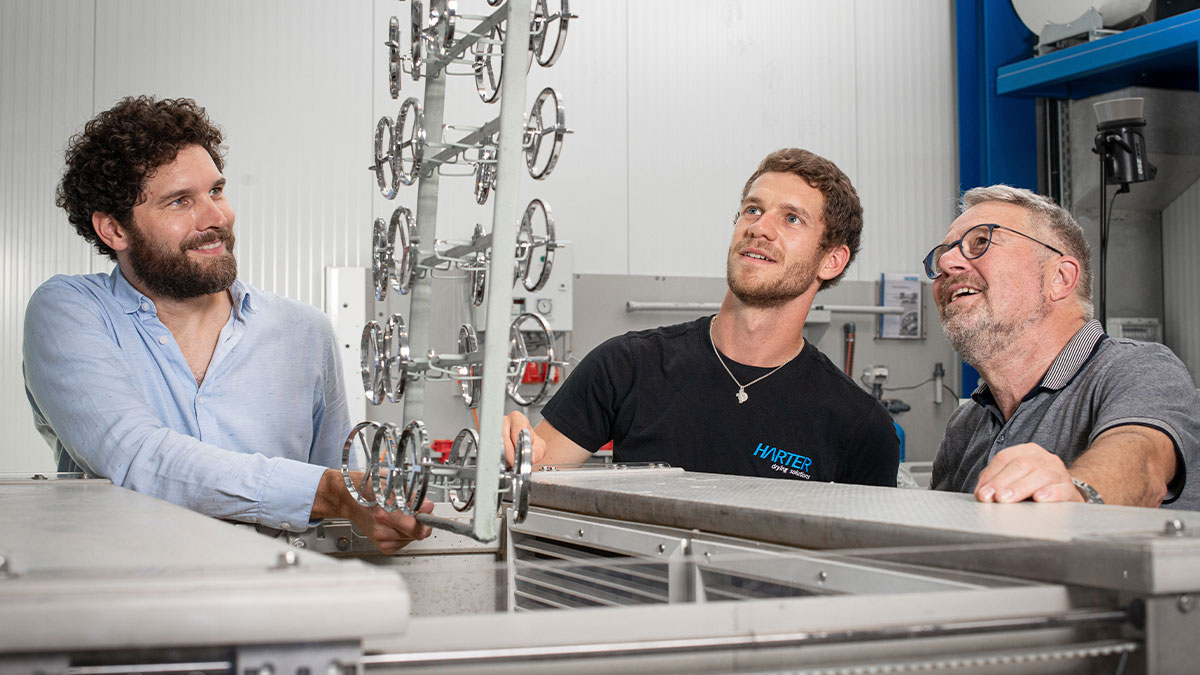
The preliminary stage plays a very significant role in drying quality because it determines how much water, dirt, chemicals, or process medium is introduced into the dryer. Rinsing, blow-off, and draining influence residual moisture, stain formation, energy consumption, cycle time, and process reliability. An efficient dryer can partially compensate for poor preliminary conditions but cannot arbitrarily offset them. For stable quality, the preliminary stage, loading, air guidance, and drying system should be designed and tested together.
Why the preliminary stage should not be considered separately from the dryer
Drying does not begin in the dryer. It starts where the product comes from cleaning, rinsing, electroplating bath, coating, or wet process. How much liquid adheres to the product, what residues are present, and whether water can drain off significantly determine the later result.
A drying system is the technical process space with air technology, dehumidification, control, and product handling. It can remove moisture, but it cannot eliminate every cause of stains, residues, or uneven residual moisture. For example, if rinse water is carried over or components drain unfavorably, the risk of quality problems increases.
For decision-makers in production, purchasing, and quality assurance, it is therefore important: The preliminary stage is part of the drying process. Offers, tests, and acceptances should not only consider the dryer but also rinsing quality, blow-off, draining time, loading, and water load. Typical applications can be found under Drying solutions by industry.
The role of rinsing in drying quality
Rinsing removes residues from cleaning, electroplating, coating, or pre-treatment. Electroplating refers to an electrochemical process in which surfaces are coated with metallic layers. After such processes, electrolytes, salts, surfactants, or other residues may remain on the surface if not rinsed sufficiently.
These residues are critical for drying. Water evaporates or is extracted, but dissolved substances remain on the surface. This can lead to stains, marks, deposits, or quality deviations. The dryer is then mistakenly seen as the cause, although the problem originated in the rinsing stage.
Important influencing factors include water quality, conductivity, temperature, rinse cascade, dwell time, product movement, bath maintenance, and carry-over. In practice, companies should check whether the final rinse operates stably enough and whether limit values for conductivity or residues are defined. A clean rinsing strategy is particularly crucial for visible surfaces, medical technology, or precision parts.
Blow-off: When it significantly improves drying
Blow-off means that liquid is mechanically or fluid-dynamically removed from the product before the actual drying process. This is particularly relevant for components with blind holes, undercuts, bores, perforations, narrow gaps, or cupping areas. Cupping components retain liquid instead of simply allowing it to drain.
A blow-off can significantly reduce the water load. This means the dryer has to remove less liquid, drying time can decrease, and the result becomes more uniform. It is important, however, that blow-off is not just localized but adapted to the geometry. Otherwise, water is merely displaced instead of removed.
Compressed air is expensive and energetically unfavorable in many operations. Therefore, a compressed-air-free blow-off with a targeted airflow can be an economical alternative. Crucial factors are air volume, nozzle geometry, distance, movement sequence, component orientation, and cycle time. Information on industrial dryer concepts can be found under Dryers for industrial applications.
Draining: Small process time with a big impact
Draining seems unspectacular but is often very effective. If products can drain for a few seconds or minutes before the dryer, the introduced water load decreases. This can reduce energy consumption, drying time, and the risk of stains. Especially for racked goods, baskets, and trays, much depends on whether water can drain freely.
The optimal draining time is a trade-off. Too short draining times increase the water load in the dryer. Too long draining times can strain cycle time, line length, and buffer areas. In shift operations, the solution must function not only technically but also organizationally.
Product orientation is also important. Components should be aligned so that liquid does not remain in pockets, bores, or folds. For baskets and trays, inclination, hole pattern, mesh size, and support points are crucial. For racks, hooks, contact points, and product spacing are decisive.
Interplay of preliminary stage, loading, and air guidance
Preliminary stage and loading work directly together. If a basket is too densely loaded, water drains less effectively, and air does not reach all parts. If trays are closed, liquid collects on surfaces. If racks hold components unfavorably, drip edges or moisture nests can form.
Air guidance means that process air is specifically directed to the moist areas of the product. Alongside dehumidification and temperature, it is one of the most important factors for uniform drying. A good preliminary stage reduces the water load, good loading opens up air paths, and good air guidance removes the remaining moisture reproducibly.
With Airgenex®, dehumidified air is circulated. A pre-cooler pre-cools moist process air, an air cooler removes moisture through condensation, an air heater brings the air to process temperature, and a process air fan ensures air exchange. The dryer interface describes the transition between air conditioning and the drying chamber. If this interface does not match the preliminary stage and loading, quality potential remains untapped.
Further background on energy-efficient drying can be found at why HARTER.
What information should be documented in tests and offers
A technical center is a test area where products are tested under realistic conditions. For reliable drying tests, the actual preliminary stage, the real loading, and the subsequent cycle time should be replicated as accurately as possible. Ideally, original parts, original baskets, racks, or trays should be used.
Rinsing conditions, draining time, blow-off parameters, part position, loading density, water load, target residual moisture, and quality criteria should be documented. Only then can it later be checked whether the series process corresponds to the tested state. Without this information, misunderstandings often arise between purchasing, production, quality assurance, and the supplier.
The offer should clearly state the assumptions on which the design is based. These include, for example: final rinse with defined water quality, draining time of a certain duration, blow-off present or not present, maximum water load per batch, and defined loading. If these points are open, dryer offers are hardly comparable.
Checklist: Review preliminary stage for stable drying quality
Realistic Example from a Medium-Sized Company
A medium-sized company with 520 employees cleans metal housings before assembly. The components have several threaded holes and small recesses. Production reports fluctuating drying results, although the dryer runs unchanged. Quality assurance finds water spots and residual moisture in individual holes.
The project involves production management, shift management, purchasing, quality assurance, maintenance, and occupational safety. Initially, it is suspected that the drying time is too short. However, tests show that the final rinse delivers fluctuating values and the components are placed in baskets without a defined draining position. In addition, an unfavorable part position retains water in the holes.
The solution is not just an adjustment of the dryer. Rinsing quality is monitored, the draining position is defined, a short blow-off is added for critical areas, and loading is documented. A typical stumbling block is implementation in shift operation: some employees load baskets differently out of habit. Only with photos, training, and spot checks by shift management does the result become stable.
If process data, user rights, or shift information are digitally recorded, IT, HR, and the works council should be involved early. For personal operator data, GDPR, purpose limitation, role rights, and deletion periods must be observed. An objective operational data collection can help to document drying programs, batches, and quality values comprehensibly, without unduly monitoring employees.
Special requirements in electroplating, food, and medical technology
In electroplating, the preliminary stage is particularly critical because chemical residues on surfaces can quickly become visible. Rinsing, carry-over, draining, and rack position influence stain-free results and corrosion risk. For barrel and racked goods, it must also be checked whether water remains between parts or at contact points.
In food production, hygiene, cleanability, and defined residual moisture are paramount. Preliminary stages can include washing, rinsing, draining, or mechanical removal of surface water. Loading carriers must be designed so that no product residues and moisture nests remain. Industry-specific information can be found under Drying in the food industry.
In pharma and medical technology, documentation and traceability are particularly important. Preliminary stage, drying, and release must be reproducible. Operator rights, recipe management, batch protocols, and change approvals should be clearly regulated. Further information is available at Drying for pharma and medical technology.
Costs, times, and economic evaluation
Optimizing the preliminary stage is often more economical than merely extending the drying time. Better draining position, adapted baskets, targeted blow-off, or more stable rinsing quality can relieve the dryer. This often reduces rework, energy consumption, and process fluctuations.
Costs depend heavily on the effort. Simple organizational measures such as work instructions, markings, or defined draining times are usually quick to implement. New baskets, special nozzles, conveying technology, or automated blow-off stations, however, may require a larger investment. The decisive factor is whether this reduces scrap, complaints, cycle losses, or energy consumption.
Companies should plan for several test runs. Often, rinsing quality, draining duration, part position, blow-off, and drying parameters must be tested in combination. For complex products, a reliable design may require several variants.
Typical Follow-Up Questions
FAQ
Why is the preliminary stage so important for drying quality?
The preliminary stage determines how much liquid and what residues enter the dryer. The better rinsing, blow-off, and draining function, the lower the water load, stain risk, and process fluctuations. The dryer can then operate more stably and often more energy-efficiently.
Can a good dryer compensate for poor rinsing?
Only to a limited extent. A dryer can remove water, but dissolved residues from poor rinsing can remain on the surface. Stains or deposits therefore often do not result from drying itself, but from residues from upstream process steps.
When is blow-off before drying useful?
Blow-off is particularly useful for components with blind holes, undercuts, bores, gaps, or cupping geometries. Water often remains there and extends the drying time. Targeted blow-off can reduce the water load and make the result more uniform.
How long should products drain before the dryer?
The appropriate draining time depends on product geometry, loading, cycle time, and water load. Sometimes a few seconds are sufficient; for complex parts, more time may be useful. It is crucial that the draining time is repeatable in the real process.
What role does loading play in the preliminary stage?
Loading influences whether water can drain and whether critical areas remain accessible. Too densely packed baskets, unfavorable trays, or incorrectly aligned racks can promote standing water. Therefore, loading and the preliminary stage should always be considered together.
Should the preliminary stage be included in drying tests?
Yes, as realistically as possible. A test with ideally drained individual parts can show better results than the later series process. A test is only reliable if rinsing quality, draining, blow-off, loading, and cycle time correspond to later operation.
Which key figures help in evaluating the preliminary stage?
Important key figures are water load, conductivity of the final rinse, draining time, cycle time, residual moisture, scrap rate, stain frequency, and energy consumption. Additionally, photos of the loading and documented process parameters can help to quickly identify deviations.


